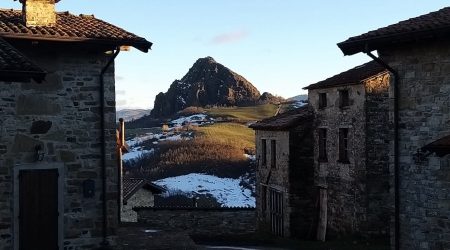
Hidden among the woods and slopes of the Piacenza Apennines, in the hamlet of Monastero di Morfasso, the remains of what was once one of the most powerful religious and political centers in the area emerge: the Abbey of San Salvatore di Val Tolla.
Founded in the Lombard era (between 616 and 680 AD) along the strategic communication routes connecting the Po Valley to Liguria, the Benedictine abbey reached an extraordinary extent between the 11th and 12th centuries. Thanks to the protection of kings, emperors, and popes – who made it independent from the local bishops – it came to control a territory of about 250 km², exercising true jurisdiction over the entire Upper Arda Valley. After centuries of decline and repeated landslides, the last buildings were demolished between the 18th and 19th centuries, causing the monastery to disappear under vegetation.
After the first surveys in the 2000s, excavation campaigns resumed in 2017 (with the contribution of universities and the Superintendency) brought to light a fascinating layering: as many as three superimposed churches from different periods, perimeter walls, a frescoed altar, and medieval artifacts, including a silver coin of Otto III. Research continues today with the aim of uncovering the entire original monastic complex still buried.
The archaeological site (locally known as the Old Church) is immersed in nature and is an ideal destination to combine with a walking excursion along the trails of the Val d’Arda.
Monastery Hamlet, Municipality of Morfasso (PC)