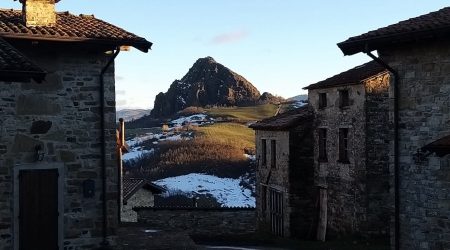
In the heart of the Piacenza Apennines, in the Morfasso area, the head of the Val d’Arda holds an extraordinary geological heritage. Here the Earth tells millions of years of history through three fascinating Geosites in Emilia-Romagna , where wild nature blends with breathtaking landscapes stretching all the way to the Alpine arc.
Monte Menegosa (1,356 m) – The ophiolitic bastion
Imposing and jagged, Monte Menegosa dominates the valley with its dark spires. It consists of ophiolitic breccias and serpentinities: ancient igneous rocks formed on the bottom of a vanished Jurassic ocean. Weathering has sculpted spectacular pinnacles and created a unique habitat for very rare rupicolous botanical species. From its summit, there is a 360-degree view of the Val d’Arda and Val Nure
Monte Lama (1,345 m) – The red liver mountain
Located a short distance from Menegosa, Monte di Lama is a regionally significant geosite famous for its outcrops of jasper (siliceous rocks with a characteristic intense red color) and Calpionelle limestones, arranged in a rare inverted stratigraphic succession. Besides its geological value, the mountain preserves an important historical memory: at its foot, prehistoric settlements linked to the extraction of flint and jasper for tool manufacturing have been found
Rocca dei Casali (866 m) – The white cliff over the valley
Descending along the right bank of the Arda stream, near the hamlet of Casali di Morfasso, rises the rocky spur of Rocca Casali. This geosite features the same rocky succession as Monte Lama (jaspers at the base and white limestone at the top), but here the layers have preserved their normal position. Today its limestone wall is a popular destination for sport climbing enthusiasts and offers a suggestive and secluded panoramic viewpoint over the middle valley.